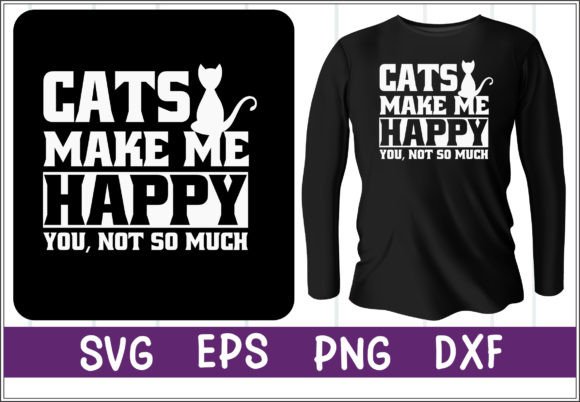
Cats Make Me Happy You Not so Much
When I first opened Cats Make Me Happy You Not so Much, I chuckled. That is exactly the kind of honest, slightly sarcastic tone that sells well in my shop and keeps customers coming back for more. The design lands firmly in the T-Shirt Designs category, but as someone who has stitched hundreds of graphics onto everything from baby onesies to canvas totes, I knew right away this piece had broader potential. The layout feels balanced without being stiff, the lettering has a hand-drawn personality that reads as authentic rather than cheap, and the cat motif adds a playful anchor that keeps the whole composition grounded. It is the kind of graphic that works because it does not try too hard — it just lands.
For context, I run a small embroidery business out of my home studio, and I test every digital embroidery file before I offer it to clients or stitch it for my own product line. Cats Make Me Happy You Not so Much arrived as part of a zip file containing an SVG format, which I know works with Cricut Design Space, Silhouette Designer Edition, Make the Cut, Sure Cuts A Lot, and Brother Scan and Cut. That alone tells me the designer considered real-world usability. As an embroidery designer, I care less about the file format and more about how the design behaves under the needle — but the fact that it is ready for multiple cutting and embroidery platforms means less prep time for me and fewer support questions from customers who buy my finished products.
First Impressions and Visual Personality
This design has a strong, readable center with enough negative space to let the fabric breathe. The text sits prominently, and the cat element adds a secondary visual hook without overwhelming the message. I immediately thought of a cream-colored sweatshirt with black thread, or maybe a soft heather grey tee with bright coral stitching. The mood is playful but not childish, which makes it suitable for teens, adults, and even crafty grandparents who love cat humor. The line weight feels consistent, and the spacing between letters suggests it will hold up well in a standard 4x4 hoop or a slightly larger 5x7 if you want to give the cat more breathing room.
One thing I watch for in any embroidery project is how a design reads from across a room. This one passes that test. The contrast between the message and the cat illustration is clear, and the overall silhouette is compact enough to fit on a tote bag panel, a cap front, or the center of a pillow cover. It does not rely on tiny details that will vanish after a few washes. That is a green flag for anyone selling handmade products or personalized gifts through an Etsy shop or at a craft fair.
Real-Life Embroidery Scenario: The Custom Tote Bag
Last week, I stitched Cats Make Me Happy You Not so Much onto a natural canvas tote bag for a repeat client who wanted a practical but funny gift for her cat-loving sister. I used a medium-weight cutaway stabilizer and a 75/11 embroidery needle with black 40-weight polyester thread. The design stitched cleanly with no skipped stitches, and the satin stitch elements in the cat illustration laid down smoothly. The fill stitch areas were dense enough to look solid but not so packed that the fabric puckered. I did a quick test run on a scrap of muslin first — always a good habit — and confirmed that the stitch density worked well for this fabric thickness.
The finished tote bag looked professional. The client loved it, and she immediately ordered two more for friends. That is the kind of response I have come to expect from designs that balance humor with clean execution. The lettering stayed crisp, and the cat shape held its edge even after I ran it through a light steam press to remove hoop marks. I would confidently stitch this onto a sweatshirt, a baby blanket, an apron, or a set of kitchen towels for a gift set. Just be careful with very thin or stretchy fabrics — use a tear-away or wash-away stabilizer and test your tension first.
Where This Design Shines in Your Product Line
From a business perspective, Cats Make Me Happy You Not so Much fits naturally into several product categories. I see it working beautifully on custom apparel like t-shirts, hoodies, and crewneck sweatshirts. It also translates well to boutique merchandise such as pillow covers, tea towels, and decorative blankets. For holiday gifts, it offers a lighthearted alternative to sentimental sayings — perfect for white elephant exchanges or stocking stuffers. If you sell digital products or printable mockups, this graphic gives you a clean, ready-to-use asset that looks good in both color and black-and-white previews.
The design also works as an embroidered patch. I have been making more patches lately for local boutiques and craft business owners who want iron-on or sew-on appliques. Cats Make Me Happy You Not so Much is compact enough to fit on a cap curved surface or a small hoop without distorting the letters. Just remember to check the hoop size before you start. If the design extends close to the edge of your hoop, the fabric may shift, especially on layered garments or thick fabrics like sweatshirt fleece. A good rule is to leave at least half an inch of clearance around the entire design.
Places to Use Caution
No design is perfect for every surface, and Cats Make Me Happy You Not so Much requires some judgment calls. I would be careful using it on very lightweight fabrics like sheer blouses or thin cotton t-shirts without a proper stabilizer backing. The fill stitch areas can pull on delicate fabrics if the tension is off. Similarly, dark fabric backgrounds may require a white or light underlay to keep the design visible if you plan to use light thread colors. I always run a black-and-white mockup before stitching to check contrast.
For curved surfaces like caps, the lettering may need slight digitizing adjustments to prevent distortion at the edges. If you are using this for a cap, test it on a curved hoop or a practice hat first. Small hoop sizes below 4x4 inches may force the text too close together, so I recommend at least a 4x4 or 5x7 hoop for best results. Also watch out for detailed corners in the cat illustration — if your machine handles dense stitch areas poorly, you may need to reduce the stitch count or simplify the shape. Always test on scrap fabric before committing to a finished product.
Visual Appeal, Stitching Clarity, and Customer Value
What makes Cats Make Me Happy You Not so Much stand out in a crowded market is its readability. Customers respond to designs that make them laugh and that look good after repeated washing. This graphic delivers on both fronts. The stitch clarity is high, the satin stitch borders are clean, and the running stitch details add texture without bulk. When I showed the finished tote bag to a few regular buyers, they commented on how professional it looked — not like a cheap iron-on transfer. That perception of quality directly affects your pricing power as a handmade shop owner or Etsy seller.
From a branding perspective, this design reinforces consistency. If you sell cat-themed products or humor-driven apparel, it fits right in. It also works as a standalone piece or as part of a collection with matching graphics. For boutique owners, it offers a reliable option that appeals to a broad audience — from millennials to older cat enthusiasts. The giftability factor is high because the humor is universal without being offensive.
Practical Notes for Embroidery Designers and Small Shop Owners
Before you use Cats Make Happy You Not so Much in your own projects, here are a few things I check with every new embroidery file:
- Test on scrap fabric first. This is non-negotiable. Even well-designed files can behave differently on your specific machine and fabric. Run a quick test with the thread colors you plan to use.
- Check thread color contrast. The design reads best when the lettering stands out from the fabric. Light thread on dark fabric or dark thread on light fabric works well. Avoid low-contrast combos unless you want a subtle look.
- Review stitch density. If the fill stitch areas feel too dense, your machine may struggle on heavyweight fabrics. If they feel too loose, the design may look patchy. Adjust stabilizer weight accordingly.
- Confirm hoop size. Make sure the design fits comfortably within your hoop. Measure the design width and height before loading the fabric.
- Inspect small details. Zoom in on the cat illustration and the letter junctions. Look for any narrow gaps that might close up during stitching. If you see potential issues, consider simplifying the design or using a larger hoop.
- Test in black and white mockups. This helps you see contrast and layout issues before thread touches fabric. It also gives you a clean preview for your Etsy listings or printable mockups.
- Compare light and dark fabric backgrounds. The same design looks different on white versus navy. Stitch a small sample on both to see which sells better in your shop.
- Use proper stabilizer. For most woven fabrics, I recommend medium-weight cutaway stabilizer. For knits or stretchy fabrics, use a tear-away or a fusible stabilizer to prevent distortion.
- Check licensing before selling. The design comes as a Graphics file intended for T-Shirt Designs and similar applications. Verify that your intended use — whether personal projects, personalized gifts, or commercial embroidery — is covered by the license terms included with your purchase.
Final Thoughts from the Worktable
Cats Make Me Happy You Not so Much is a solid addition to any embroidery designer’s library. It delivers on humor, readability, and real-world stitch performance. Whether you are making a custom embroidered tote bag for a friend, stocking your boutique shelves with cat-themed apparel, or designing a line of digital embroidery files for other makers, this graphic holds up under the needle. It works across a range of products — t-shirts, sweatshirts, baby onesies, caps, aprons, pillow covers, kitchen towels, and more — and it appeals to the kind of buyer who values personality over perfection.
I have added it to my rotation for personal projects and client orders alike. The file format is widely compatible, the design is well-composed, and the finished product earns the kind of customer trust that keeps people coming back. If you are on the fence, stitch a test run on a plain tote or a scrap of cotton. I think you will see exactly why this design works so well in real embroidery work.